Wastely: A 4-Day Design Sprint to Reduce Food Waste
A globally distributed team of designers came together for a remote four-day design sprint to design a novel solution to a "wicked" environmental problem, going from expert interview to tested prototype in less than a week.

Context
Wastely is the result of a four-day design sprint conducted remotely by a group of designers from around the world who wanted to find a novel solution for reducing food waste. The team came together when facilitator Christina Maury reached out to the Design Buddies community with an invitation to collaborate using the AJ&Smart Design Sprint methodology.
The final team was made up of aspiring designers spread across the globe. To overcome geographic barriers, Discord was chosen as the main communication platform for its reliable video calling and free channels. Figma and FigJam were used for real-time collaboration throughout every stage of the sprint.
The Sprint Team
Each team member took on a specialized role in addition to contributing to the prototype and usability tests:
- Christina Maury, Facilitator and Group Organizer
- Linh Le, Lead Designer and The Decider
- Bob Ruediger, Lead Interviewer and Assumptions Board Manager
- Christina Maresca, Lead Recruiter
- Janice Jons, Designer and Researcher
- Kathrina Tacastacas, Designer and Researcher
The Problem
Prior to starting the sprint, democratic voting between team members was used to choose food waste reduction as the problem space. Issues like natural resource depletion, greenhouse gas emissions, and the growing scale of landfills are directly connected to global food waste, making it a "wicked" problem with environmental, social, and logistical dimensions simultaneously in play.
The Solution
Wastely is a food waste reduction app that makes it easy for users to find thousands of recipes, resources, techniques, and organizations aimed at reducing food waste. It rewards users for reducing their own waste at home and sharing their techniques with the community, combining practical utility with social accountability.
Define the Challenge and Produce Solutions
Expert Interview
The team kicked off with an expert interview with Ms. Alma Nejenhuis, a co-op founder and food waste and environmental studies educator from the Netherlands. Her key insight framed the entire sprint:
"There isn't a convenient way for all people to access reliable information about what they can do with food they already have and how they can make smarter choices when buying groceries."
The interview established that most food waste begins at home, and the obstacles to addressing it are wide-ranging: cultural, economic, and informational.
"How Might We" Questions
Reflecting on the expert interview, the team used the "How Might We?" method to surface long-term goals and sprint questions:
- How might we create a database of waste reduction ideas and recipes?
- How might we make the platform accessible regardless of social status?
- How might we encourage the sharing of information and ideas?
- How might we shift perspectives and attitudes toward food waste?
- How might we overcome limited internet access in some regions?
Long-Term Goals
Provide a platform where anyone can share and retrieve helpful ideas. Make reliable information about food waste reduction accessible to all.
Sprint Questions
Can we create a product that encourages people from all backgrounds to share creative food waste reduction ideas? Can we reward users for sharing? Can we ensure information is always safe and reliable?
Ideation
Story Mapping, Crazy Eights, and Final Concept exercises were used to generate and evaluate a wide range of product ideas. My storyboard, called "Picture Perfect," mapped the actions of someone using an app to inventory fridge contents with their camera. While not the selected concept, elements of it made it into the final prototype.
Crazy Eights ideation session, generating solutions fast, without attachment.
Curate, Vote, and Storyboard
Final Concept Decision
The straw poll method was used to select the winning concept: each team member cast one vote, then the Decider (Linh Le) made the final call. She chose "The Google of Food Waste Reduction," a storyboard designed by Christina Maresca, which proposed an app with a simple home screen affording three core options: give or receive unwanted food, chat with community members, and learn ways to reduce food waste.
User Test Flow
Each team member individually wrote six action steps for the user test flow. The group voted on their favorites, and the action steps I wrote were chosen as the foundation, a gratifying moment of collaborative validation.
Storyboarding
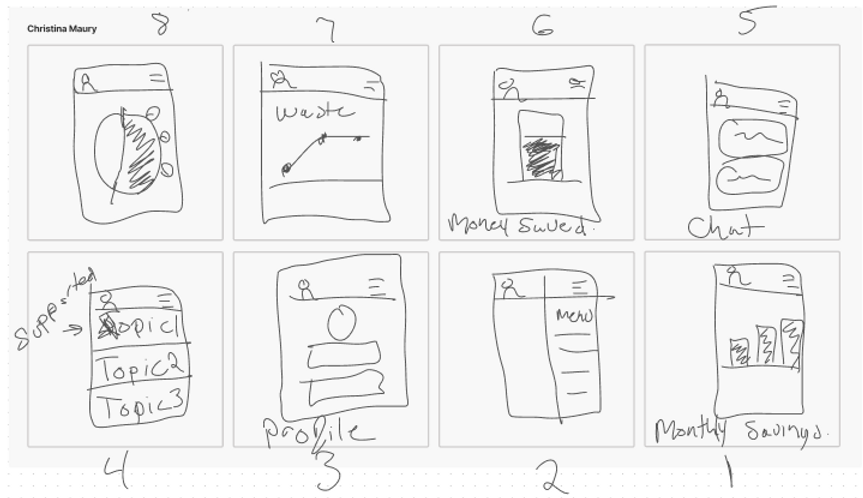
The rest of Day 2 was devoted to drawing the prototype storyboard: eight screens, starting from app sign-up and ending at the success criterion of users finding a reliable resource for using the food they already had at home.

The eight-screen storyboard guiding prototype development.
Build the Prototype and Recruit
Day 3 was devoted to building the Figma prototype. The entire sprint team contributed to the build throughout the day. Simultaneously, Christina Maresca led participant recruitment and I collaborated with her on writing the final test script.
The prototype included a home page with the three core options, a food inventory screen, a tailored recipe results view, and a food waste reduction community post view, each screen designed to test a different aspect of the core experience.

Wastely home page, the entry point to recipes, community, and food waste resources.
Test with Real Users
Participants
Five participants were recruited specifically because they were responsible for grocery shopping and meal planning in their households, the primary audience for a food waste reduction app. The group spanned five countries: USA (two participants), UK, France, and the Netherlands.
Test Tasks
Task 1: Use the app to input the food currently in your fridge and get suggestions for what to do with it. Task 2: Find a great meal idea for after your next shopping trip. Task 3: Find what others are saying about alternative food waste reduction options like fermentation.
Feedback
Participants responded enthusiastically to the recipe functionality and the social aspects of the app. "It's very easy to find and save recipes" and "The scientific articles seem more trustworthy than what I find on Google" were two standout quotes. Key criticisms centered on unclear navigation, inventory items not ordered sensibly, and unclear validation of resources, all addressable in iteration.
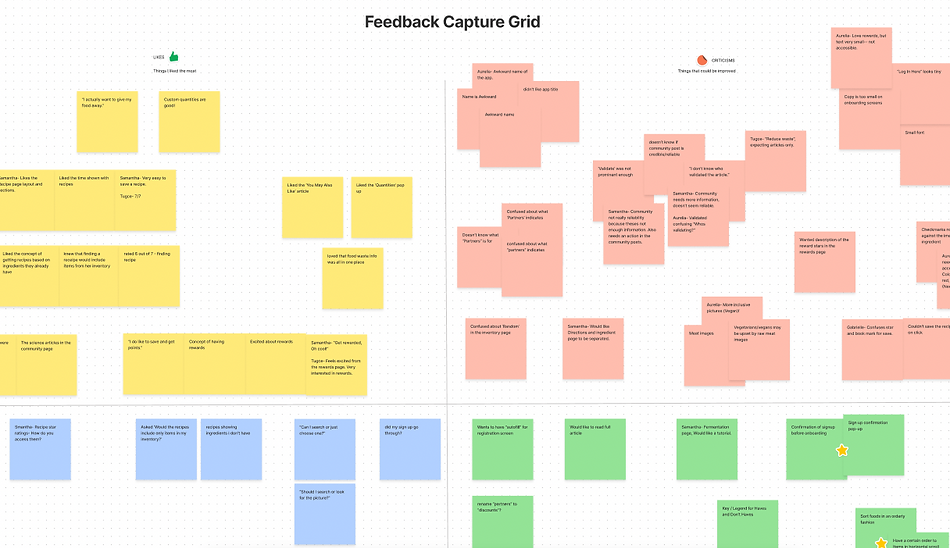
Feedback capture grid from Day 4 usability tests, organized in FigJam.
Results
Wastely was well received across all five test participants. The benefit of the product was clear to everyone who tried it. The experience of working with an internationally distributed team on a compressed timeline was both exciting and formative: there were moments of being stuck, overcome through strong communication and mutual trust.
One test moment stands out. During our first usability session, the participant I was interviewing hit a dead end in the prototype. I casually directed her to a previous screen while other team members quickly fixed the issue, and I guided her back into the flow before she noticed. That kind of real-time, cross-team coordination under pressure, compressing four months of work into four days, is what this kind of sprint is really testing.
Reflection
Wastely is currently a shelved concept, but the team has not dissolved. Future steps include potentially expanding the original team and applying what we learned to another design sprint, with me taking on a facilitation or Decider role next time.
The biggest takeaway: design sprints are a genuine test of team communication and trust. The compressed timeline doesn't leave room for ego or process debates. You either collaborate well and ship something real, or you don't. This team did.